Which decision the journey map should clarify

A journey map shows stages, questions, emotions, channels, objections, and actions needed to move forward.
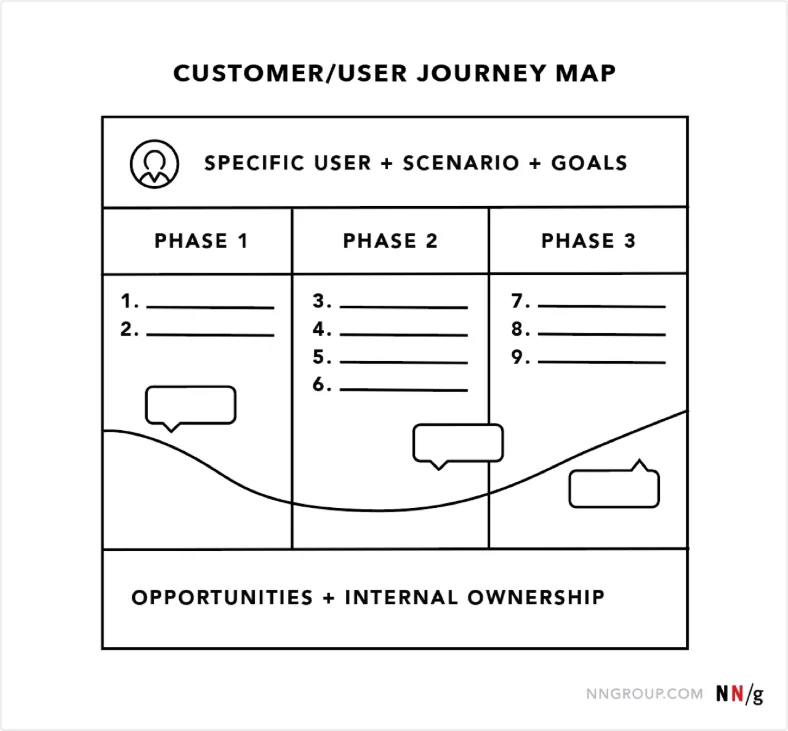
The journey connects what a person does with opportunities for improvement.
Source · Nielsen Norman Group
Supported bystages, questions, emotions, channels, objections
The risk of mapping from assumptions

Teams often optimize isolated channels. Customers experience a full sequence with changing context.
How to turn evidence into a journey
Build the map with real sales, support, analytics, and short interview inputs instead of assumptions only.
Implementation checklist
- Define one audience and one purchase goal.
- Map stages from discovery to repeat purchase.
- Note questions, objections, and channels by stage.
- Find moments where follow-up is lost.
- Assign content, UX, or automation improvements.
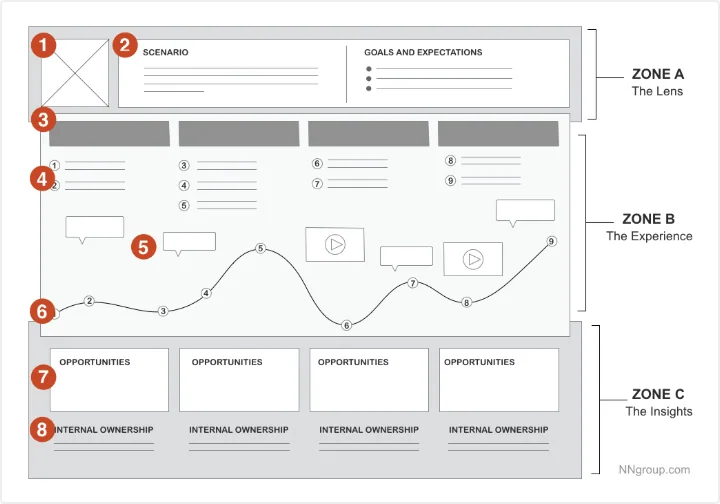
The structure separates the scenario, experience, and actions the team can take.
Source · Nielsen Norman Group
Supported byshort interview inputs
Changes the map should be able to measure
Measure drop-off by stage, decision time, repeated questions, contact rate, satisfaction, and repeat purchase.
The map earns its value through changed decisions
A journey map does not need to illustrate every possible emotion. It needs to show one task, the touchpoints affecting it, and the available evidence. When the team fills gaps with assumptions, mark them as hypotheses rather than presenting them as the customer's voice.
Work with a specific journey, such as buying for the first time or renewing. Mixing discovery, purchase, support, and repeat purchase on one line produces a large mural and few priorities. Several smaller maps are usually more useful.
End the session by assigning a problem, an owner, and a measure. Improve the whole journey is not a task. Reduce the time between form submission and first response is. Precision turns empathy into operations.
What should survive the workshop
- The customer task and journey boundaries.
- Evidence confirming each friction and valuable moment.
- Three prioritized changes with an owner and date.
- A metric and qualitative signal for reviewing the result.
Supported bycustomer journey mapping
Quick execution map
| Element | What to review | Quality signal |
|---|---|---|
| Intent | A journey map shows stages, questions, emotions, channels, objections, and actions needed to move forward. | The answer is clear within seconds. |
| Implementation | Build the map with real sales, support, analytics, and short interview inputs instead of assumptions only. | There is one concrete and assignable action. |
| Measurement | Measure drop-off by stage, decision time, repeated questions, contact rate, satisfaction, and repeat purchase. | The data should change a decision. A report with no action adds work. |
Frequently asked questions
What does customer journey map mean in practice?
A journey map shows stages, questions, emotions, channels, objections, and actions needed to move forward.
What is a sensible first step for customer journey map?
Define one audience and one purchase goal. Then continue with this action: Map stages from discovery to repeat purchase.
Which problem should customer journey map prevent?
Teams often optimize isolated channels. Customers experience a full sequence with changing context.
How do you measure progress with customer journey map?
Measure drop-off by stage, decision time, repeated questions, contact rate, satisfaction, and repeat purchase.