

Intent defines which page should exist
A search intent map connects query groups with the page that can complete the user's task and a coherent next step.

The format of results offers clues about the task the person is trying to complete.
Source · Screaming Frog
Supported byGoogle Search Central: helpful, people-first content
When two URLs compete for the same task
Creating an article for every variation produces duplicates. Sending every search to a sales page also fails learning and comparison needs.
How to assign query, format, and destination
Inspect result types, language, and expected depth. Change the map when evidence shows that an intent has shifted.
Implementation checklist
- Group queries by problem and result similarity.
- Name the task the person wants to complete.
- Assign the right page, format, and depth.
- Define the link to the next journey step.
- Find gaps, duplicates, and pages mixing intents.
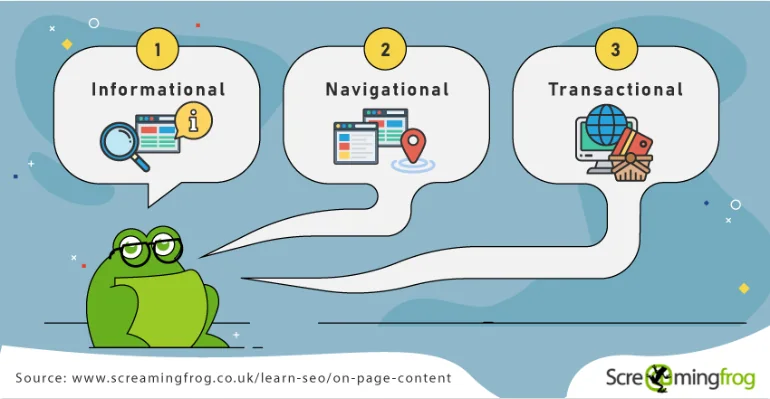
Naming the task helps choose a guide, an offer, a comparison, or a tool.
Source · Screaming Frog
Supported byGoogle Search Console: Performance report
Changes that require a map review
Measure shared rankings, CTR, query shifts, internal navigation, conversions, and pages competing for the same group.
Assign each intent to one page
Inspect actual results to learn which format satisfies the query: guide, category, service, comparison, or tool. The term alone does not reveal that.
When two pages solve the same task, choose the canonical owner and redefine the other. Cannibalization is often an architecture problem before it is a keyword problem.
Record intent changes. A query showing guides today may become commercial as the market changes.
Map fields
- Query and user task.
- Dominant result type.
- Owning URL.
- Gap or editorial action.
Supported byGoogle Search Central: SEO Starter Guide
Quick execution map
| Element | What to review | Quality signal |
|---|---|---|
| Intent | A search intent map connects query groups with the page that can complete the user's task and a coherent next step. | The answer is clear within seconds. |
| Implementation | Inspect result types, language, and expected depth. Change the map when evidence shows that an intent has shifted. | There is one concrete and assignable action. |
| Measurement | Measure shared rankings, CTR, query shifts, internal navigation, conversions, and pages competing for the same group. | The data should change a decision. A report with no action adds work. |
Frequently asked questions
What does search intent mapping mean in practice?
A search intent map connects query groups with the page that can complete the user's task and a coherent next step.
What is a sensible first step for search intent mapping?
Group queries by problem and result similarity. Then continue with this action: Name the task the person wants to complete.
Which problem should search intent mapping prevent?
Creating an article for every variation produces duplicates. Sending every search to a sales page also fails learning and comparison needs.
How do you measure progress with search intent mapping?
Measure shared rankings, CTR, query shifts, internal navigation, conversions, and pages competing for the same group.