A bot answer depends on its knowledge base

The knowledge base should include services, visible prices, policies, FAQs, processes, brand voice, and escalation criteria.
What happens when nobody owns the knowledge

If the bot lacks trusted sources, it improvises or gives incomplete information. That creates commercial and trust risk.
Supported bydocument the provenance and dependencies of sources feeding the system
How to prepare content the bot can cite
Organize documents by topic, define what the bot may answer, and define what it must route to a person.
Implementation checklist
- List public pages, policies, and approved internal documents.
- Write model answers for common questions.
- Mark limits around pricing, legal, support, and human decisions.
- Update sources when an offer changes.
- Review conversations to find gaps.
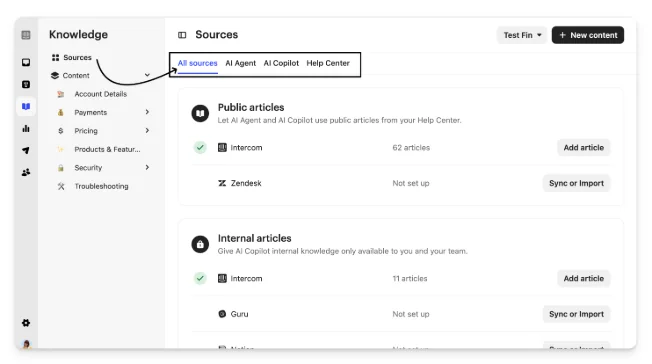
The panel separates the sources available to each support channel.
Source · Intercom Help
Supported byprotect permissions, ingestion, and retrieval in a shared knowledge base
Tests before opening the chatbot
Measure resolution, correct escalation, satisfaction, unanswered questions, time saved, and corrected errors.
A knowledge base needs an owner and current documents
Uploading files does not create a reliable source. An old contract, a current page, and an internal deck may contradict one another. Before indexing, decide which source wins for price, policy, scope, and contact details. The bot should abstain when that priority is unclear.
Split content around questions a person would actually ask and preserve the title, date, owner, and URL. Fragments without context can retrieve a correct sentence for the wrong situation. Metadata helps limit language, product, audience, and validity.
Test difficult questions alongside happy examples. Include misspellings, out-of-scope requests, comparisons, and questions with no available answer. A good evaluation counts when the bot cites, escalates, and admits it does not know.
Knowledge maintenance routine
- Remove or mark replaced versions before reindexing.
- Assign authority and review date to every source.
- Keep links that let people verify the answer.
- Repeat a fixed question set after every change.
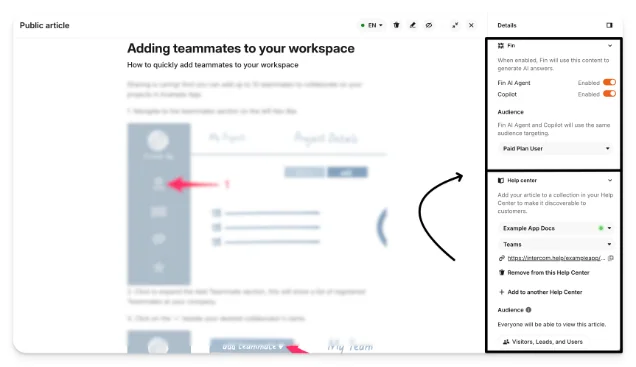
The article audience limits who can receive that information.
Source · Intercom Help
Supported byintegrity and data-leakage risks in vector indexes
Quick execution map
| Element | What to review | Quality signal |
|---|---|---|
| Intent | The knowledge base should include services, visible prices, policies, FAQs, processes, brand voice, and escalation criteria. | The answer is clear within seconds. |
| Implementation | Organize documents by topic, define what the bot may answer, and define what it must route to a person. | There is one concrete and assignable action. |
| Measurement | Measure resolution, correct escalation, satisfaction, unanswered questions, time saved, and corrected errors. | The data should change a decision. A report with no action adds work. |
Frequently asked questions
What does AI chatbot knowledge base mean in practice?
The knowledge base should include services, visible prices, policies, FAQs, processes, brand voice, and escalation criteria.
What is a sensible first step for AI chatbot knowledge base?
List public pages, policies, and approved internal documents. Then continue with this action: Write model answers for common questions.
Which problem should AI chatbot knowledge base prevent?
If the bot lacks trusted sources, it improvises or gives incomplete information. That creates commercial and trust risk.
How do you measure progress with AI chatbot knowledge base?
Measure resolution, correct escalation, satisfaction, unanswered questions, time saved, and corrected errors.